Brass pestle
The Brothers KaramazovThe Brass pestle is a small household tool that becomes one of the most consequential objects in the investigation of Fyodor Pavlovich’s death. Dmitri Karamazov takes it during his frantic departure from Fenya’s home and later drops it in his father’s garden. Because it is presented as the weapon used in the supposed murder, the pestle carries both material evidence and interpretive weight: its presence is certain, while what Dmitri intended when he took it remains fiercely contested.
From household implement to carried object
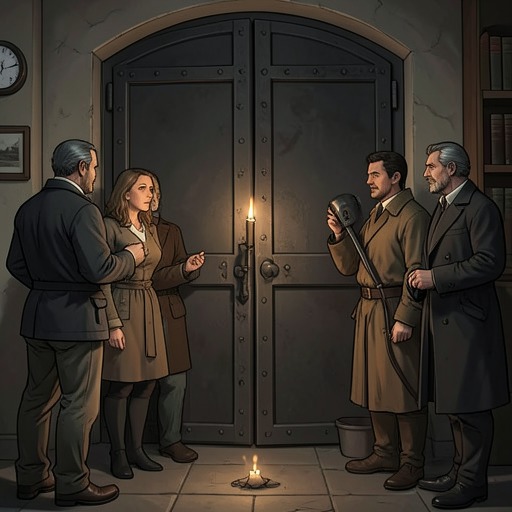
The pestle first appears on a table, set inside a brass mortar. It is described as small, no more than six inches long. As Dmitri hurries out, he has already opened the door with one hand when he snatches up the pestle with the other and puts it into his side pocket. Fenya and old Matryona witness the unexpected act. Fenya fears that he is going to murder someone, but the scene establishes only that he takes the object and leaves in haste; it does not settle why he takes it.
The gesture gives the pestle a new function before it is used. A commonplace implement becomes conspicuous because Dmitri deliberately carries it away, turning the object itself into a question about intention. The later argument over whether the act was purposeful or impulsive begins with this simple, observable fact: the pestle was on the table, and Dmitri chose to put it in his pocket.
In the garden
Later, as Dmitri is beside himself, he pulls the pestle from his pocket. At the moment of the confrontation in the garden, Fyodor cries out, and Dmitri jumps back over the garden boundary. He bends over his fallen father with the pestle in his hands, then flings it mechanically into the grass. It lands not in the grass but on the path, two paces from Grigory, in a conspicuous place.
The pestle’s course is therefore traceable: from the table to Dmitri’s pocket, from the pocket to his hand, and from his hand to the garden path. The narrative records its location and handling without resolving the disputed question of motive. Its visibility after the encounter also makes it available to later observers and investigators as a physical link between Dmitri and the scene.
Evidence and disputed intention
At Dmitri’s trial, the pestle lies on the table of material proofs, beside Fyodor Pavlovich’s blood-stained white silk dressing-gown and Dmitri’s blood-stained shirt and coat. Its presentation as the fatal pestle places it among the concrete exhibits on which the case against him is built. The exhibit can show that Dmitri possessed the object and brought it to the garden; by itself, it cannot establish what he planned or what happened in the decisive moments.
The prosecution interprets the earlier snatching as evidence of preparation. It argues that Dmitri had been contemplating a plan for a month, that he took the pestle because he already understood any suitable object could serve as a weapon, and that he acted deliberately rather than unconsciously. In this account, the pestle’s selection is not an incidental detail but a sign of prior intent. The prosecution also places the garden scene in the context of jealousy and the belief that Grushenka was with a rival, using the object to connect motive, opportunity, and the alleged killing.
A later argument for the prosecution likewise treats the pestle as the weapon used in the assault, describing the killing as probably accomplished with one blow. These claims remain part of the case made against Dmitri, not an independent confirmation supplied by the object. The contrast between the recorded action and the prosecution’s explanation is central: the narrative shows the pestle being taken, held, and dropped, while the trial assigns those acts a deliberate meaning.
Narrative significance
The pestle moves from background object to evidence through a sequence of actions that repeatedly bring it into view. Its small size and ordinary setting contrast with the grave accusation attached to it. Once carried out of Fenya’s house, it cannot remain merely a household implement: in the garden it becomes associated with the confrontation, and in court it is displayed as material proof.
Its force in the case depends on both what it can and cannot establish. The object gives the accusation a tangible center, but its presence does not erase the difference between possession and intent. The same act—Dmitri taking the pestle—can be read as evidence of advance planning or as an ambiguous gesture made during a hurried, turbulent evening. That unresolved distinction makes the pestle more than a prop in the investigation: it is the point where visible fact and disputed interpretation meet.